
Dietary Guidelines for Americans: Added Sugar
As we progress through our deep dive of the 2025–2030 Dietary Guidelines for Americans, the recommendations just keep getting better. The USDA has finally taken a very aggressive stance on sugar. It’s about time.
The average adult in America consumes about 17 teaspoons (68 grams) of added sugar a day. That’s about 272 empty calories. While that might not sound like a lot, it equates to 1,904 extra calories a week—enough extra energy to assemble a half-a-pound of fat.
We eat a lot of sugar. It’s in just about every packaged food item there is—not just in the obvious sweet foods, but also in peanut butter, salad dressing, ketchup, barbeque sauces, canned soups, lunch meat, bacon, hot dogs, pretzels, chips, roasted nuts, canned fruit and vegetables, and breads. Sugar is the biggest driver of our obesity epidemic, and the reason 50% of adults in the U.S. have pre-diabetes or diabetes.

The new dietary guidelines state that “no amount of added sugar is recommended or considered part of a healthy diet.” They even give a practical ceiling that no single meal should contain more than 10 grams of added sugar. They also draw an especially important line for early life: children under 4 should consume zero added sugar.
They recommend avoiding sugar-sweetened beverages, sodas, fruit drinks, and sugar-containing energy drinks. And in another striking shift, they recommend limiting low-calorie/non-nutritive sweeteners (like aspartame and sucralose), along with artificial flavors, petroleum-based dyes, and preservatives.
The guidelines also cite that higher intake of sugar-sweetened beverages is consistently linked with increased risk of type 2 diabetes (+39%), cardiovascular disease (+20%), obesity (+17%), depression (+25%), tooth decay (+57%), and all-cause mortality (+10%).
They Really Got This One Right
Added sugar is, without a doubt, the number one cause of America’s health epidemic. Sugar-sweetened beverages are the worst offender. Nearly half the adults in the U.S. (it’s probably not a coincidence that about the same number are obese) consume 12 to 16 ounces of sugar-sweetened beverages a day. That’s 52 grams of sugar—about 200 calories of concentrated glucose with almost no satiety, no fiber, and no meaningful nutrients.
It’s not just the sodas. It’s the sports drinks, energy drinks, and craft coffees. They’re everywhere, and American’s drink a lot of them.
The advice for children under 4 to consume zero added sugar is spot on. Early exposure to highly sweet foods trains a child’s taste buds and reward circuitry to crave sweetness. That sets the stage for a lifelong pattern of ultra-processed foods, higher obesity risk, and metabolic dysfunction later in life.
And finally, the government is taking a stand on replacing sugar with chemical sweeteners. There’s no free lunch. Yes, non-nutritive sweeteners reduce calories on paper, but emerging evidence suggests they can influence gut bacteria, appetite regulation, and glucose responses.
Being Practical
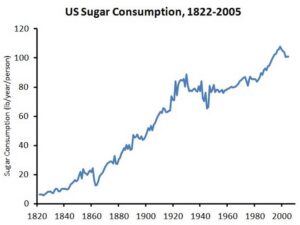 Sugar is more addictive than cocaine. It’s important to avoid it as much as possible. But that’s not easy. And food manufacturers are very clever about hiding sugar in processed foods. The Added Sugar Repository has composed a list of 262 names of added sugar. Their list extends beyond information provided by the FDA and includes specific examples of U.S. food products for each added sugar. Clever may be an understatement.
You don’t need to memorize 262 names to limit your consumption of added sugar. To help identify sources of added sugar, look for ingredients that include the word “sugar” or “syrup” or end in “-ose.” Ingredients are listed on food labels in descending order by weight. The ingredient constituting the largest amount is listed first and the smallest last. If a sugar is listed as one of the first three ingredients on a food’s label, don’t eat it.
Food manufacturers have also learned to hide or sneak sugar into foods. Instead of using a lot of one type of sugar, they will often use smaller amounts of two or three different types of sugar. That puts the sugars farther down the ingredients list, hiding them.
If more than one type of sugar is listed on the food label, it has too much sugar. Don’t eat it. Oh, and as a general rule, if you don’t know what an ingredient is on a food label, it’s not food. Don’t eat it.
Bottom Line
Eat more fruits and vegetables. Learn to cook with limited amounts of sugar—or no sugar at all.
Stay Strong and Keep it Simple,
Bo Railey
