
Staying Safe in the Heat
Earlier this year The Old Farmer’s Almanac predicted a scorcher of a summer, with “hot and dry” conditions across most of the United States (it predicted “hot and wet” for Indiana). Last summer (2024) was one of the hottest summers on record with a nationwide temperature 2.5°F above normal. This summer could be even hotter.
 Heat waves are the deadliest weather events in the U.S., killing more than twice as many people as any other. In 2023, there were more than 2,300 heat-related deaths in the U.S. The official fatality count is probably a lot higher because deaths from heart attacks or kidney disease on hot days aren’t generally included. Climate scientists at Texas A&M estimate the number of deaths from heat in 2023 was more likely around 11,000.
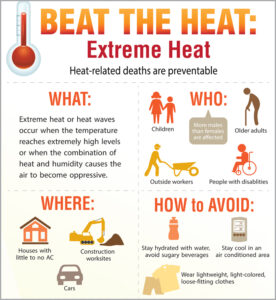
Adults over 65, particularly those with chronic health conditions, are most vulnerable to heat. Infants and young children are also more vulnerable than the rest of us because they don’t sweat like adults. Taking precautions in the heat is important for your health and your survival. Hopefully these tips will help you stay safe this summer, especially when you’re outside for 2 hours or more at a time.
Know When to Play it Safe
Thermometer readings and humidity levels aren’t the only factors determining safety in regard to heat. In 2024, the CDC along with the National Weather Service launched a tool called HeatRisk, which takes into account other factors like how unusual the heat is for the time of year, duration of the heat during the day and night, and whether temps are in the top 5% for a given location.
The index shows a map of the U.S. with areas coded in red where the heat factors pose a major risk. If your area is red, anyone without effective cooling/and or adequate hydration can be negatively affected by the level of heat, not just people who are susceptible due to age or other health conditions.
Not paying attention to the heat could lead to a major heat illness like heat cramps, heat exhaustion, or heat stroke.
Heat Cramps
Heat cramps are severe, sustained muscle spasms. They can occur during or after physical activity and result from an imbalance in the body’s fluid level and electrolyte concentrations.
The solution for heat cramps: get plenty of water and more salt. The average person needs 8 to 12 cups of water a day to handle normal activities and about 2400 mg of sodium a day to maintain a healthy electrolyte balance. Most of us don’t drink enough water to begin with, and many of us don’t get enough sodium because we’ve been told to avoid it at all costs.
A few tips to avoid heat cramps include:
- When you work in the heat and sweat constantly, you should drink one cup of water every 20 minutes.
- If you work in a hot climate for more than 2 hours, add a pinch of salt (150 mg of sodium) to your water.
Heat Exhaustion
 Heat exhaustion is the body’s response to an excessive loss of water and salt, which often happens during the first summer heat wave when people have not acclimated to the heat. Heat exhaustion occurs when your circulatory system can’t adjust to the rapid depletion of body fluids. Plasma volumes drop and your body directs blood circulation toward the skin for cooling. This drastically reduces central blood volume and makes it difficult for your heart to keep up.
Symptoms of heat exhaustion include rapid pulse, headache, dizziness, weakness, and nausea.
A person who experiences symptoms of heat exhaustion should move to a cooler environment; remove unnecessary clothing; apply cold compresses to the head, face and neck; and sip cold water. If symptoms persist for more than 20 minutes, go to an emergency room or call 911.
The best way to avoid heat exhaustion is to be proactive:
- Make sure you exercise regularly by strength training once a week and doing 30 minutes of physical activity every day.
- Maintain a healthy weight. Excess body fat acts like insulation. This is great in the winter, but it can cause real problems in the summer. Fat keeps heat deep in your body from travelling to your skin where it can dissipate. Obese people are 3.5 times more likely to experience heat exhaustion or heat stroke.
- Follow the example of animals. You seldom see wild animals running around in the hot part of the day. They are most active in the early morning and late evening, and they rest during the hottest periods of the day. If you need to work outdoors on a hot day, get outside before 10:00 am or after 6:00 pm.
Heat Stroke
Heat stroke occurs when the body’s core temperature reaches 105°. A person experiencing heat stroke will have an altered mental state, red skin, headache, fast pulse, and dizziness. Typically, a person experiencing a heat stroke has completely stopped sweating.
If someone you know exhibits heat stroke symptoms, call 911 immediately, then take steps to lower their body temperature. Move them to a cooler place. Take off as much clothing as possible. Put ice on as much of their body as possible. The quicker you act, the better. One in three people who survive a heat stroke end up with some sort of permanent disability.
The best way to avoid heat stroke–pay attention to how you feel.
- If you work in the heat and you start to feel dizzy or nauseous, stop and get to a cool place.
- Put cold compresses on your head, neck and back.
- Drink more water than you think you need and add some salt.
Overhydration Is the Key
Overhydrating is the most important thing you can do to avoid a heat-related illness while you work in the heat. Remember, sweating is your body’s main way of cooling itself. Your body also cools itself by diverting blood flow from your internal organs to your skin where it can cool.
 Sweating a lot leads to more serious fluid loss, which reduces your blood plasma volume. This puts your body in a crisis because your working muscles demand more blood flow at a time when your body tries to divert more blood to the skin’s surface for cooling. Once you become dehydrated, there is less blood to divert to the skin for cooling because your body views blood flow to your muscles as more important.
You lose more water when you work in a hot environment. The average person performing moderate activity for one hour at 80° will lose about 2 cups of water. That same person will lose 4 cups in an hour of moderate activity at 100°. For every 4 cups of sweat lost during dehydration, your heart rate will increase by 8 beats per minute.
If you plan on working in extreme heat, follow this hydration plan:
- Drink 2 cups of water before you go to bed.
- Drink 2 cups of water immediately when you wake up.
- Drink 2 cups of ice water 20 minutes before physical activity in the heat.
- Drink one cup of ice water every 20 minutes while you work in the heat.
- Add a pinch of salt to your water if you work in the heat for more than 2 hours.
- Drink an additional two cups of water for every pound you lose from working in the heat.
Also, pay attention to your urine. If it’s yellow or dark, you’re not drinking enough water.
Stay Strong and Cool!
Bo Railey
